A Rough Night for Rockin’ Ricky

Gremlins (1984)

Joe Dante’s festive fable meets creature feature, Gremlins, shares its slimy birthday with another childhood staple of mine—Ghostbusters. The summer of ’84 peculiarly heralded the arrival of these two, genre-bending faves. I discussed my love for Ivan Reitman’s supernatural, SNL cast-caper on our recent HalloRe’ewind podcast and blog alongside Devlin, and mentioned a Ghostbusters & Gremlins double bill would’ve been preferable to my eventual Ghostbusters & Ghostbusters II pairing, but Gremlins is (along with Die Hard) my go-to Crimbo flick, and it seemed so much more appropriate to pick it here.

I’ve had a realisation over the last couple of weeks about these Rewind throwback films. We sometimes ask ourselves, “Do they hold up?” Perhaps we should be asking how much we’ve changed. Do we hold up? Have we forgotten who we were? The films don’t alter—unless George Lucas made them. Frame for frame, Gremlins is the same movie I saw as a kid. I feel the same way about Gremlins as I did back then, except I tend to turn my nose up at some of the more overtly childish, slapstick Dorry’s Tavern scenes, which I’ve aged out of a bit, but thoroughly loved as a boy.

How often have we heard fanboys moaning about the rubbish Star Wars prequels, and characters like Jar Jar Binks? It’s a kids’ film! Kids like Jar Jar. Yes, the prequels are inferior, but you love the originals because they captured your youth. You’re reframing something to fit you, but you’re fifty years old! Gremlins hasn’t altered, but the same can’t be said for me. It’s 2020; I am George Lucas’ Special Edition of Matt—and who says that’s an improvement? I often think I was a finer, purer judge of films as a kid, with that innocence and no agenda.

Brilliantly termed “icky mayhem” by Leonard Maltin, Gremlins desecrates the American Christmas fairytale in a dark, anarchic manner. It’s both mischievous kiddie horror, and jet-black satirical comedy; as unique as the strange creatures it portrays. For me, what makes Gremlins truly stand out from the crowd as a twisted little gem, is the way it acts as an essential annual antidote to the typical saccharine fare surrounding us this time of year.

Apparently, in ’84, filmgoers returned in droves to cinemas the second weekend after Gremlins’ initial release. I did too—not to the pictures, as I was only two years old, but once it was circled in the Radio Times, taped off the telly, and I’d claimed that VHS as my own, it was rewound and rewatched too many times to count. As I confessed with James Cameron’s AliensGremlins is like an old friend, and an absolute must-watch each year at Christmastime. It may turn some folks off—typically the more mature, traditionalist members of your household, but to quote Marty McFly, “Your kids are gonna love it.”

Everybody Be Cool

When did you first hear the words “Quentin” and “Tarantino?” The Tarantino explosion of ’96/’97 (for me anyway—most older people were aware of him much sooner, but I was only ten when Reservoir Dogs came out, so give me a break) was a multiple film initiation, as if Reservoir Dogs, True Romance, Pulp Fiction, Natural Born Killers, Desperado, Four Rooms, and From Dusk Till Dawn, were all sat on the QT shelf, just waiting to be discovered. Unlike today, I didn’t have to wait two or three years for a new Tarantino movie—they were all just there. Directed by him or not, I could gorge on them; this major “hit” of perhaps seven, life-altering films in quick succession. It was like finding a great band and sifting through their back catalogue, impressed with everything they did. Quentinmania had gripped my secondary school; not so much the girls though, who I remember were more into Trainspotting at the time, but the lads, certainly.

I first saw Pulp Fiction on a school sick day. It was kindly rented by my mum, as per, due to it being an 18 certificate, top-shelfer. She, of course, chose Mia’s gory, “madman” heroin overdose scene to walk in on, and likely regretted her decision. I was completely gobsmacked. I’d never seen anything like it. Tarantino became the biggest director to me since Steven Spielberg. It was the first evidence of a true auteur. Not just a director; a writer/director. This opened up my mind to what films and filmmakers truly are, or could be. I coveted that “written and directed by” role ever since, in spite of finding it extremely difficult to write my own material; at least until my time at film school, where I was actively encouraged, and directed a few of my own scripts. QT was my “in” to everything cinematic beyond the usual TV repeats of the era’s most popular films, and the accessible, pop cultural, commercial fare surrounding everyone in the ’80s and ’90s.

I saw Reservoir Dogs next, at my friend, Rob’s house. I think his mum rented it this time from the same local video shop; Cav’s (the one I always namecheck on The Rewind Movie Podcast), but I had to leave just before the very end, so I rented it again immediately to catch the full, uninterrupted resolution—after Rob returned his, of course, as there was only ever one copy of anything. Occasionally, villagers would pop in to rent a Hard to Kill and Nico double feature tape, a C. Thomas Howell film perhaps, or something like One Tough Bastard or The Delta Force, and see the dreaded, red “ON LOAN” tab. You’d then have to reserve it and wait a few days.

On a family holiday in 1994 to Hong Kong, I recall noticing my uncle David had a couple of pretty edgy t-shirts—no doubt from one of the many cheap, unofficial clothing markets there. One was Janet Jackson’s topless 1993 Rolling Stone cover shot with someone’s hands covering her boobs from behind, the other was a bald Woody Harrelson with little, round, red sunglasses and the title, Natural Born Killers. Although the violent and controversial film was directed by Oliver Stone, and disowned entirely by Quentin, who only received a story credit, he was somehow guilty by association and became a notorious, wanted man; his name, a cool and dangerous one. Natural Born Killers was banned outright in Ireland, and delayed a theatrical and video release in the UK due to the Dunblane Massacre. Alongside a VHS of True Romance, a dodgy bootleg copy, or imported version of NBK, circulated my school; possibly from Germany or Holland. It had slightly shoddy, unofficial artwork, and an over-sized, ex-rental style, plastic case.

Desperado was next, as I’d heard it had a QT connection—he appears briefly and tells a piss joke. Notably, it was also my introduction to the incredible Salma Hayek, Cheech Marin, and Danny Trejo, who would all pop up in Dusk soon after. This was a VHS purchase first, but I later bought an early El Mariachi/Desperado double bill on a flipper disc DVD. This was my real introduction to Robert Rodriguez, and the concept of low (or no) budget indie filmmaking, as it included his award winning short, Bedhead, an insightful and beyond inspirational, Ten Minute Film School, and feature debut, El Mariachi, with a commentary to end all commentaries on one side, and Desperado on the other with Ten More Minutes, a Hollywood stage follow up to the Ten Minute Film School. It ignited something, and for years, fuelled my interest in independent filmmaking; planting a seed that would eventually send me off to film school to follow in the footsteps of my cinematic heroes (sort of, as neither RR nor QT really attended one). I always told myself I was going for the equipment and the experience, not the education. Above all, I wanted an opportunity to use their 16mm Arriflex and Aaton film cameras, and work with like-minded people.

My contribution to Richmond School’s Tarantino craze was From Dusk Till Dawn, which I owned on VHS on first release in ’97. A lad (previously mentioned in my Demolition Man blog intro as the Lynx deodorant huffer) borrowed it, then lent it to a friend, who passed it on to a mate of a mate, and it was gone forever. But there is an upside to this tragic tale. The DVD I subsequently bought to replace the thieved Dusk tape had extensive bonus features, my favourite ever commentary, a terrific making of in Full Tilt Boogie, deleted scenes, etc. So thank you to whoever nicked off with my video – you actually did me a favour.

I went to college to study journalism for a couple of years when school ended, but the film, TV, and radio modules were all more appealing than the dull, regimented newspaper writing, so with a love of film already burning within me, I pursued that instead. In fact, on our first ever film, Night Class, myself and best mate, Sam, peculiarly thanked Earl McGraw (the Michael Parks character from Dusk) for his inspiration, and included the quote, “We’ll get ’em… we’ll get ’em” in the end credits. Only now do I fully understand how impactful and influential From Dusk Till Dawn, and its makers were.

Dusk (along with Peter Jackson) also inspired my British film on vampire lore, which I attempted to shoot on black and white 16mm, using a clockwork Bolex around 2010. Devlin (eye gouge) and Gali (throat slash) patiently sat for makeup tests by my sister, Anna. Unfortunately, due to a lab error, we lost a lot of footage and were forced to abandon it.

Sarah Kelly’s insightful making of From Dusk Till Dawn, entitled Full Tilt Boogie, opens with a fictionalised, spoofy segment of Larry Sanders proportions, with Quentin and George playing skewed versions of themselves, mugging, and generally speaking, being faux-assholes. Also, Quentin’s assistant, Victoria Lucai (name-checked in Death Proof during Rose McGowan’s bar story) is sent on an errand to retrieve Tarantino’s treasured Wacky Races mug, as “He needs it on every set.” We meet some lovely people, some strange and wonderful characters, such as adventures in craft service’s Ken Bondy, the sweet art direction team, who sadly burn half the Titty Twister set down by mistake, but discover it still looks great. There’s the 2nd or 3rd AD that doesn’t care about the creative process, and the quirky “career extras.” Among other things, Full Tilt taught me what an AD actually did. Here seems like the perfect opportunity to draw attention to Gali’s excellent first AD work on my 2007 graduation film, The Wilds, along with superb camera assistant, Devlin.

Full Tilt Boogie also interestingly highlights the issues QT producer, Lawrence Bender, faced when selecting a non-union shoot for Dusk. Their hardline rules were against his crew’s approach to filmmaking. In particular, the blurring of lines between departments troubled them, e.g. Rodriguez was the one-man show poster boy; a Rebel Without a Crew, renowned for editing his own work, operating his own camera and Steadicam, and generally speaking, making films in his trademark Mariachi-style. Dusk seems to have been targeted as it featured a successful, high profile, cast and crew. The union could easily make an example of them. In my eyes, Bender and company were essentially standing up for indie film. They fought for their idea of what filmmaking can and perhaps should be. Full Tilt Boogie brilliantly illustrates the possibilities when filmmaking is conducted with a family element; its camaraderie, and on set relationships—romantic and otherwise, feel warm and genuine.

Dusk is not without faults. I favour its practical effects over the shoddy computer morphing, but it’s fine. It’s all a bit schlocky and cheap and nasty at times, but it fits somehow. It’s very 1996. Nothing takes me out of the film, really. I even have a fondness for Ritchie’s “I love you too, Seth” roaring digital face transformation. It was one of the scariest parts of my early viewings. The Superman-vision, hostage in the boot shot during the opening titles nails the feeling RR and QT were after. It’s befitting of exploitation horror, and sets the perfect tone for the dark humor in the vein of something like Evil Dead II. The deleted scenes reveal a few other poorly rendered effects, such as a vamp swooping down to attack. There is at least one seriously dodgy effect in the movie, where Jacob is about to strike Frost and he suddenly melts down. I love the giant animatronic rat! It’s really one for the Fangoria crowd. The CG shot of the bats swarming outside also holds up nicely, and the ace matte painting of the pyramid at the end makes for a worthy closing image.

Described as “brothers” by Robert’s ex-wife, Elizabeth Avellan; Robert and Quentin first met on the festival circuit promoting their debut films, El Mariachi and Reservoir Dogs. The duo came together for Dusk due to a duplicitous scheme. One executive told Rodriguez’s agent, if Robert agrees to direct, Quentin will come on board to rewrite. The other told Tarantino’s people, if QT rewrites the script, Robert will direct. The ruse worked and brought the friends together once again after already collaborating on 1995’s Desperado and Four Rooms. At Dimension Films (Scream, Scream 2, The Crow, The Faculty), a division of Miramax, Robert and Quentin got all the perks; 100% approval of casting, promotional materials, and final cut—which was totally unheard of, and no one else had.

I have a real soft spot for Quentin—his honest, emotional nature and innocence actually. The word “geek” gets thrown around, but that’s a little too derogatory and dismissive of someone with such cinematic clout. Yes, he’s a bit eccentric. His twitchy energy and gesticulating in interviews is intolerable to some; Vincent Gallo had a go at him a while back for being a “day and night” California weed king, but if he’s conceiving of, and creating the caliber of movies he does high, then I say leave him be.

To me, Tarantino’s deep film knowledge, unbridled enthusiasm for all things cinema, and undying passion for filmmaking, make him my favourite working director (alongside his buddy and worthy contemporary, Paul Thomas Anderson). He’s the one I leave my house for every single time—to go to the cinema and see a Tarantino film on the big screen. There are almost no directors like that left, and I’ll be heartbroken when he concludes his ten-film directorial run, and retires from filmmaking to be a gentleman of leisure, and work on his novels and film criticism books. I also get the feeling I won’t be alone. Some of these QT naysayers will miss him too, because the saying is true—you don’t know what you’ve got ’til it’s gone.

Express Elevator to Hell (Goin’ Down)

Aliens (1986)

James Cameron’s action-packed, balls-to-the-wall, Southern Comfort meets The Magnificent Seven follow up to Ridley Scott’s sci-fi horror classic, Alien, was first released around this time in the summer of ’86.

I was about 9-years-old, like Newt, when I first saw Aliens on television, and I must’ve been completely obsessed by the time I was 10, as each month throughout 1992, my mum would order me the Aliens magazine from our local newsagents. The magazine featured gory comic excerpts, movie trivia, a fervent fan letter section (which I felt intimidated by, and regrettably never contributed to), and mail-in order offers for items such as a £100 replica of Ripley’s leather jacket, which I was never wealthy, nor geeky enough to pull the trigger on. I’d read them and reread them obsessively, copying the pictures carefully and colouring them in.

At the time, there were several films I couldn’t watch with my family due to bad language, as I’d be, no doubt, told to switch it off. There are 25 uses of “fuck” in Aliens; 18 of them spewed by Bill Paxton‘s hysterical Hudson. Insane levels of bloody, ’80s violence, as seen in Die Hard, RoboCop, Total Recall, and Predator, and a topless Linda Hamilton in The Terminator, would also secure these films a place on heavy rotation in the Sunday morning club when my dad was at church and my mum was busy making Sunday lunch.

I slummed it for years, watching a butchered for telly, ITV taping (I think) of Aliens, with carefully chopped out adverts and news reports. This copy featured daft, dubbed lines like, “You don’t see them frigging each other over for a goddamn percentage.” This censored theatrical cut was the version that formed all my initial responses, but little did I know, there were always two incarnations of Aliens floating around—the theatrical, and the special edition. I treasured that TV taping as my sole, go-to copy until I finally acquired the special edition VHS, which was fortuitously on UK shelves early, from 1990 onward. When I did finally see Cameron’s director’s cut, with its extra 17 minutes of Xeno-goodies, it felt like Christmas morning.

Theatrical vs special edition is a loaded question, as I feel there are indispensable additions, but also some superfluous ones. The theatrical comes in at a hefty 137 minutes already, and Jim’s cut runs at 154. In Aliens: Special Edition, it’s a case of “this time it’s more.” No doubt, fans will bicker over the validity of certain new scenes. For example, take the re-implanted, family-orientated Hadley’s Hope, with the tricycle kid (Kubrick much?) and the terraformers’ expositional discussion regarding Burke and Weyland-Yutani’s intentions. Its purpose is to both illustrate company orders, and emphasise the importance of the family unit, which is cued up with Ripley’s crushing, “families” response to Van Leuwen; a great lead-in line, which works fine on its own, but has ultimate power when preceding a hard cut to Hadley’s Hope.

However, there’s a lot to be said for leaving these scenes out completely, as the implication is already there, and in many ways, it’s more terrifying to hear, “We’ve lost contact with the colony on LV-426.” The comic, Newt’s Tale, does the trick in terms of filling any gaps in the story. In one instance, poor Newt sees her mother impregnated across from her. There was always the potential for this to happen in the film, and to have Newt witness it moments before Ripley enters and breaks apart her cocoon, freeing her. Personally, I think it’d be a tad too busy. Besides, we’ve seen a chestburster already, and an effective impregnation, of sorts, with Newt’s dad and the facehugger. It also creates the problem of what do we do with her mother after that? Ripley killing Newt’s mum is an avenue we absolutely don’t need to go down.

I enjoy the sentry guns sequence as it adds a thicker layer of pressure, pre-ceiling crawling Alien attack, but when it’s seamlessly expunged in the theatrical, I don’t miss it at all. In fact, with the reactor ticking down, and Bishop’s dropship subplot, there’s enough waiting around, and the imminent Alien breach really kicks things into gear for the remainder of the film. So, although it has merits in terms of mounting claustrophobic tension, the overall pacing is improved without it. There’s also some clearly reused footage of exploding Xenomorphs.

My first instinct, when assessing the special edition, was to keep it all. I just wanted to see everything. This brings up an important quandary regarding pacing, and crucial reveals of information. I can understand the initial removal of the early Hadley’s Hope colony scenes, as the producers simply had to get the running time down, and Gale Anne Hurd’s suggestion to remove that entire reel was a wise one.

Critically and commercially speaking, would the special edition have been as successful as the theatrical, or even more so? Who knows, maybe the impact of seeing Aliens for the first time in its special edition presentation would’ve been dulled somehow by its pacing and length. I personally doubt it, but it is debatable. I’m definitely not an objective opinion here, as I’d happily accept another hour or so of Aliens, and to hell with the pacing.

There’s a cut of Aliens inside my mind that is better than anything currently available; a custom edit I’d love to see play out in context. The fact that I’m still craving a cut incorporating the CBS TV broadcast premiere scenes from 1988, depicting the fabled cocooning and death of Burke, speaks volumes. The long-discussed scene of Bishop crawling in the tunnel, and encountering an Alien, would also make an interesting addition, but it appears to be apocryphal and appears only in the novelisation.

I enjoy the nuances, such as the subtle moment between Ripley and Hicks, in which they reveal their first names—Ellen and Dwayne, although I think Cameron could’ve done better than Dwayne. A tiny moment earlier, where Hicks asks if Ripley is ok before entering the colony may have been removed simply due to timing, but perhaps also because Hicks asks Ripley if she’s ok again immediately after the dropship crash and the ensuing wreckage. We get it, he fancies her, and wants to protect her at all costs. This repeated behaviour is all to further Cameron’s adoptive family setup—Hicks (the father), Ripley (the mother), and Newt (the daughter). Certain shots were carefully framed to visually illustrate the trio as a functioning family unit; the most notable being post-facehugger attack, as Ripley states, “Burke. It was Burke.” Due to this important, overarching plot line, I think these little additions are all extremely valid.

Growing up, without really knowing what a director actually did, James Cameron was certainly in my top four filmmakers, alongside Steven Spielberg, John McTiernan and Joe Dante. There is a caveat: I only really consider his great work to be The Terminator, Terminator 2: Judgment Day, and Aliens. Everything else pales.

When I first heard the tale of Cameron’s fiery endoskeleton fever dream, him immediately painting the T-800 from memory, and then building what would become The Terminator story around that singular image, I was immediately insanely jealous; wishing I could have that experience. Now, with the Harlan Ellison plagiarising factor, I’m a little more skeptical of Jim. It’s a bit like when John Lennon’s Beatles origin myth, where he claimed to have dreamt about a flaming pie and a voice that told him, “You are ‘Beatles’ with an ‘a’.” Much like Jim’s, that story eventually folded under the truth that Lennon simply picked a name with a double meaning that sounded a bit like Buddy Holly’s band, The Crickets; but print the legend by all means, it’s usually more interesting, and often makes the creator seem like a genius.

Titanic fans will no doubt disagree, but where can you really go after Judgment Day? Everything Jim did after T2 was bloated, as if boredom had skewed his interest and integrity. The years that followed saw him obsessively diving for the wreckage of the Titanic, then announcing and apparently making a bunch of Avatar films no one asked for, and we’re yet to see any real evidence of—not that I care. I’m yet to meet one person who is excited about Avatar 2, or felt a sequel, or prequel, was even remotely warranted, let alone five or whatever silly number he’s up to.

I also feel, looking (or more honestly, not looking) at Alita: Battle Angel, that the digital film revolution has ruined many things when it comes to cinema; it also ruined Jim, along with Robert Rodriguez—an early, no-budget filmmaking hero of mine. This digital nonsense has severely affected the quality their output. With the dwindling Terminator sequels ranging from daft to dire, I’m not even remotely interested in Cameron’s take on The Terminator or Alien franchises anymore, or anything else for that matter. It’s not the ’80s or early ’90s anymore; the glory years are over, and I’m over Jim.

Cameron himself may be ostentatious to the point of nausea at times, particularly these days, but he had the goods to back it up at the beginning; a captivating sense of deliberation and control, resulting in some truly magical cinema. We’ll always have his three masterpieces. They’ll last forever, and when you’ve made two of my top ten films of all time (Aliens and T2), my hat’s off to you. Stellar job, Jim.

Alien fans are sticklers, and Cameron was a brave man to take on the sequel. For the most part, I love his attitude throughout this era. The boozy British crew were undoubtedly at odds with him. They were Ridley Scott fans, and objected to “Grizzly Adams” waltzing in with his pixie wife and taking over the gaff. It was just another job to them. All the while, Jim was killing himself daily to carve out his vision and get it on camera the way he envisioned it. It was his moment, and he took it; no thanks to them.

Granted, the “sequel master” shows us things we’ve seen before, but he also ups the ante. Take the Alien warriors—their movements are more wide-ranging, and appear to be a massive advancement on the first in terms of their physicality. However, I personally prefer the often stationary, or calm and collected, slower movements of the creature in the first film. Aliens’ Xenomorphs can appear more like mindless drones, as opposed to perfect organisms, but they needed to be fallible, so it’s forgivable. For this particular film, that was what was required of them. Alien has some flawless one-on-ones; Kane and the egg, the ambiguous, yet palpably sexual violation of Lambert, Parker’s tense undoing, that classic Dallas jump scare, and Brett’s chain-dangling, watery face off. They’re all slasher movie 101 set pieces, done artfully and stylistically, and each has its own beauty, with the steady, calculated movements of the Alien, the unfurling of its tail, and the whole haunted house aesthetic. But Aliens needed to be more overt. Clearer. We wanted to see more crawling, running, jumping, and although the rubbery suits and limp arms of the creatures jar a bit in 2020, it’s where that next step needed to go.

Jim knows what to leave out too. I don’t think Cameron believed he could, or needed to top the facehugger scene from Alien, so he didn’t even attempt it. It’s brilliant. We all know it. It transcends the film. It’s firmly in our memories, in pop culture, and it doesn’t require a retread. Cameron wisely ups the stakes in unexplored areas, where the technology of ’86 could outdo Scott’s ’79 vision.

When Bishop, the seemingly kindly “artificial person” says, “Magnificent, isn’t it?” in reference to the facehugger specimens, and holds a lingering, suspect glare with Spunkmeyer, it’s all Cameron; cleverly playing on the series’ sneaky AI expectations by referencing Ash, Ian Holm’s chilling, murderous company android from Alien. This shrewd game leads to a satisfying payoff, with Bishop’s heroic actions aiding Ripley at the denouement, and even physically grabbing Newt to rescue her after being sacrificially torn in two. Yes, Cameron gives us another robot, but he uses our prior knowledge to play us.

I don’t believe Cameron was trying to top Alien, necessarily. Aliens was designed as a sequel, not a remake; a “combat film”, as opposed to a gothic horror. Jim is respectful of the original, and as a fan, clearly adored it, and wanted to walk in Scott’s shoes as a world creator. As Cameron once said, “Alien is a funhouse with things jumping out of the dark. Aliens is a roller coaster. You can see what’s coming, but you can’t stop it.” The word I kept returning to was extension; he extends the universe, the story, and the characters. Cameron didn’t create this world, but he interpreted it logically, and then broadened it. He developed the creatures beyond the walls of the original, expanding upon their life cycles and behaviour. He added to the synthetics, revealing more about their protocols and rules, and built upon Ripley’s character, adding the death of her daughter, and haunted, recurring dreams, to propel her towards the action once again.

For Cameron, the leap from The Terminator to Aliens in just two years is astounding. The Terminator, although a sci-fi horror classic in its own right, has its roots in low-budget filmmaking. Aliens is a powerhouse spectacular, fizzing with all the bells and whistles of a true blockbuster. What is often overlooked, I think, is Jim’s practical, hands on approach, and his use of just about every trick in the book to get his images on screen.

They don’t make ‘em like they used to. For anyone thinking, “alright, grandad”; particularly younger folks, an entirely practical approach offered a tactile element – the puppets were really there, on set, with no one looking up at tennis balls on sticks at something that’ll be figured out later in post. The crew built them, tested them, and I imagine, based on the rubbish bin bag queen test, panicked drastically, then worked incredibly hard to make it work for camera.

The Alien queen could very well be the pinnacle of film puppetry, requiring 14-16 operators to function. Ripley’s escape from the queen, under flickering electric light is a masterclass; hiding and revealing the creature to the exact degree required, to both instill terror and retain mystique. It’s a piecemeal task, but a worthwhile one. There are, I imagine, lots of starts and stops, taking a few frames from here, and a few frames from there. That’s a good looking snarl! That dripping goo looks decent, and that movement feels real for however many frames. This accomplishment is testament to the filmmakers—the excellent editor, Ray Lovejoy (2001: A Space Odyssey, The Shining, Batman), in particular, as well as effects magician, Stan Winston (Predator, Terminator 2, Jurassic Park) and his team.

Although I don’t wish to disregard the VFX guys and girls behind their computer screens, there’s something to be said about purely practical work. Teams of puppeteers (it took nine people just to make the facehuggers in the stasis jars move) who, with the aid of smoke and mirrors, can achieve an in-camera effect, which doesn’t require any further embellishment. There’s a purity to it. For me, perhaps alongside the T-Rex from Jurassic Park (aided beautifully by CG in this instance), the Alien queen is the greatest animatronic puppet ever assembled, and sadly the last of its kind. It existed, and was photographed; not added in later, and it shows. When you’ve experienced practical effects like this, how can CGI ever measure up? Aliens will look great forever (unlike Fincher’s Alien 3, which although having my favourite Alien warrior in the dogburster (or oxburster, depending on which cut you prefer), is damned to the annals of early CG nonsense where audiences will giggle and point at it in perpetuity.

Not all directors fall victim to sucky CG. Some superb work goes unnoticed, as it’s so subtly done. Denis Villeneuve has a firm grasp of it. Christopher Nolan’s Dark Knight trilogy, I felt, was particularly restrained, and offered up some striking, believable imagery. I do think most modern CG will age out rapidly due to its continuously evolving nature. Contradictorily, some argue it peaked with Jurassic Park—one of the first examples of its use, so who knows. Maybe we’re going backwards. It could come to pass that early, and some contemporary CG, with the exception of the big guns like Jurassic Park, will soon appear more dated than Aliens. Perhaps we’ll look back on Avatar and laugh, but aside from some hokey rear/front projection plates (I’ll concede that’s one occasion where Prometheus-level CG would’ve come in very handy), and the typical issues of a few dated costume and hair designs, I don’t think Aliens will ever fall victim to the same pitfalls as these CG-laden blockbusters.

James Horner’s majestic, often mimicked or pinched score is a vital component in the success of Aliens. Robert Rodriguez nabbed “Bishop’s Countdown” from the Aliens OST and used it to great effect in the From Dusk Till Dawn trailer. Even Die Hard got in on the action with an unused piece called “Resolution and Hyperspace” being selected by McTiernan for the climactic dispatch of Karl.

Gale and Jim, at that stage of their careers, clearly didn’t understand the time and approach required to effectively score a feature. All their bravado, and threats to sack Horner showed bad form on their part, and quite embarrassingly reflected their green approach to collaborating with a composer. Their inexperience played a destructive part. If you’re after The Terminator’s rudimentary chase scene music, a chimp can knock that off on the black keys of a Casio keyboard in thirty seconds. This is anything but a throwaway score. It’s emotive and layered, moving and sweeping. Fact of the matter is, Horner needed a locked picture cut before he could really dig in and time out the cues. The producers were down to the wire, and it caused rows. Jim picked his battle wisely in retrospect, as the rumour was he focussed his undivided attention on approving the myriad sound effects, rather than the music, which was already being spearheaded by the more than capable Horner. In 2003’s Superior Firepower documentary, Hurd says Horner didn’t finish the music on time. Maybe so, but only because you failed to provide him with a locked picture cut, and sufficient time to score. This clearly ate into Horner’s four-week recording window, and that’s what resulted in delays. Then, when Horner did eventually deliver, the couple moaned because it didn’t have every moment they’d discussed previously, precisely at the times agreed upon. How could Horner possibly achieve that without a picture lock? It’s an impossible request. I still feel he not only delivered one of the strongest scores of all time, but also miraculously managed, against all odds, to keep somewhat of a cool head with the troublesome producers. It’s a true testament to the man.

Back in the days of Drew’s Script-O-Rama (which endearingly hasn’t altered to this day), which we’d visit during our media and film studies courses to learn how to correctly format scripts, I’d often reference the stark, expressive opening lines of Cameron’s Aliens screenplay.

I hadn’t seen the original Alien when I first saw Aliens. Alien is often viewed as a liberal-leaning, leftist, feminist masterpiece, and in opposition, Aliens a pro-Republican Nam allegory, in staunch defence of the nuclear family. To an extent, I think the shoes fit, but I detect more intentional feminism in Aliens than in Alien.

I can’t think of a scene more moving and heroic than the selfless return to nightmarish horror Ripley embarks upon in the third act of Aliens. A bereaved mother’s surrogate relationship with an orphaned colonist named Newt leads to one of my favourite moments in cinematic history – the gearing up in the elevator scene, in which Ripley holds her promise, and boldly goes back to rescue the little girl after a traumatising abduction. It’s a quest only a mother’s love could possibly explain, and yet there’s no shared blood between the two. It’s heartrending, adrenalising, and precedes one of the all-time great sci-fi movie battles: Ripley vs the Alien queen.

Although it’s a carbon copy of the original Alien trailer, the sublime, wordless Aliens teaser is still outstanding. Seeing it in a cinema would’ve been monumental. I’d’ve been there on opening night in a heartbeat. It doesn’t fall victim to the usual pitfalls of most modern trailers, and does exactly what it’s supposed to do: tease us.

Notably, castmembers, Lance Henriksen (Bishop), Jenette Goldstein (Vasquez), and Bill Paxton (who very nearly took Bobcat Goldthwait’s Zed role in Police Academy 3: Back in Training, prior to being scouted out to play Hudson), all reunited for future-ex-Mrs Cameron, Kathryn Bigelow’s rock and roll vampire flick, Near Dark, a year later in ’87.

If you have any interest in seeing the invariably clueless old duffer duo, Siskel & Ebert, dismiss this total work of art in six minutes flat, you can find their asinine review of Aliens in the YouTube playlist below. The only borderline interesting insight was Ebert’s chestburster time bomb argument that Newt may have been carrying an Alien embryo inside her when the marines arrived, and that justified her place in the film as a device for tension and drama, and she was not simply a “child in peril” cheap shot, as Siskel put it.

Aliens remains a dark action piece with a warm human centre, utilising the profound theme of committing to another person when it may mean your life. As the late, great, Bill Paxton once said, in reference to Cameron, he really made it “snap, crackle, and pop.”

I’m firmly team Scorsese on the whole Marvel Universe, Disney behemoth, Star Wars remake machine, and the theory of the infantilisation of cinema—these dummies in shorts and baseball caps, still feuding, and banging on about Star Wars aged 40. However, Aliens happened to be my Marvel Universe. It was my superhero movie. My franchise, or whatever you’d call it, or at least one of them, alongside Indiana Jones and Back to the Future. So, I both identify with, and pity the Star Wars lot, and the Marvel kids, because my favourite film when I was 9 was infinitely better than theirs.

There are no more video boxes as such, all the Blockbusters are dead, and the HMVs are dying; it’s hard enough finding DVDs and Blu-rays in the shops here in Korea—everything is streamed now. That being said, I hope there are still a few kids out there, staring at posters, or Netflix images (or whatever they do these days) of fascinating films; wondering what they could possibly be about, and waiting on tenterhooks to finally see them, never forgetting what drew them to it initially, and then getting immeasurable pleasure and satisfaction from the final film like I did with Aliens.


Rat Burgers, the Three Seashells, and the Hunka Chunka

Demolition Man (1993)

Mellow greetings. I think my twelve-year-old self would roll his eyes if I said anything other than Demolition Man is a fun, rip-roaring slice of ’90s action cinema. I have little desire to pick it apart too much. I’m fiercely loyal to the films of my youth, particularly these days, and will fight Demolition Man’s corner purely because it gave me so many wasted years of daft entertainment and big laughs when I needed them. Admittedly, I should’ve been studying a little harder, and not demolishing valuable brain cells by rewatching a gurning, grunty, thawed out caveman diving about the place.

“Ubiquitous” is an adjective we chuck around when selecting our Bargain Bin films for The Rewind Movie Podcast, and in the small town of Richmond, North Yorkshire, circa 1994, Demolition Man was most certainly that. During secondary school, I owned the VHS tape, and can vouch for its widespread popularity as I was the mug lending it out non-stop to friends, and against my will, to dreaded friends of friends. Fortunately, it was always returned safe and sound—unlike my From Dusk Till Dawn video, which was sadly lost forever, courtesy of a permanently baked lad, who used to huff Lynx deodorant through his school jumper.

Marco Brambilla’s Stallonian sci-fi opus was omnipresent. Every boy at school must’ve seen it at least once. When me and my fellow Judderman, Rob, weren’t drinking Metz and watching Evil Dead II, passing film quote notes under the door of our adjoining classrooms, making fun of our English teacher—”Vigo the Carpathian”, making bizarre To Kill a Mockingbird board games, or kicking Chelsea buns down the street, we’d often quote Demolition Man – cracking in-jokes about our rubbish ice cream van school lunches by labelling the subpar patties, “rat burgers.” I also recall mimicking the irreverent lunacy of Wesley Snipes’ Simon Phoenix with a totally different group of friends between our occasionally violent card games of “Raps”, and playing “Heads and Volleys.”

Upon a recent double rewatch in preparation for the podcast, it was peculiar to recognise just a handful of names from the opening titles; far fewer than my usual average. The director, Brambilla, in particular, I knew absolutely nothing about. Turns out I was also a fan of his ’97 sophomore effort, Excess Baggage (or maybe just a fan of Alicia Silverstone). An Italian-born, Canadian video artist; Brambilla’s filmography from 1999-2020 consists solely of video installations. One name, however, leapt immediately off the screen like an exploding building. Before I figured out what a producer even did, I was a disciple of Joel Silver. From the Lethal Weapon series, to Commando, Predator, and personal favourite, Die Hard—his films were among the ones I would loop on a regular basis. Old pro, Alex Thomson BSC, also shot Stallone’s Cliffhanger the same year as Demolition Man, as well as previously serving as director of photography on childhood faves, Labyrinth and Alien 3, Schwarzenegger’s Raw Deal, Ridley Scott’s fantasy adventure, Legend, Michael Cimino’s Year of the Dragon with Mickey Rourke, and Death Line aka Raw Meat—a ’70s London Underground cannibal horror, reminiscent of 2004’s Creep. Thomson also worked as camera operator for the brilliant, Nicolas Roeg, in the ’60s.

From the opening shot of the Hollywood sign in flames to a G.I. Joe-lookin’ bloke in a beret; bungee jumping out of a helicopter, yelling “PPHHOOEEENNIIIXXX!!!” at the top of his lungs, you know exactly where you stand. Switch that brain off. You won’t be needing it. It’s big, dumb action, but I found it delivers more than we’re perhaps expecting; certainly more than we’re used to from a ’90s actioner. It could’ve descended into unwatchable territory in the hands of another director, but for my money, Brambilla gave it a solid grounding, and paid attention to some crucial details. Perhaps this is too generous, but the way Spartan eyes the Cryotube as he initially goes into stasis is a smart visual setup for the final scene, which has him freezing Phoenix. Many directors would’ve missed that tiny trick, and, although a microscopic detail, it illustrates Brambilla knew how to relay information quickly and clearly.

For me, Demolition Man holds up. It works particularly well in a meta movie double feature with another self-referential action film of the same year, Last Action Hero, with the bigger man himself, Arnold Schwarzenegger. I was an Arnie advocate, through and through. Generally speaking, I maintain he made better films than Sly. When it came to Stallone, I wasn’t a Rocky kid, but I enjoyed aspects of First Blood, and absolutely loved both Cliffhanger and Demolition Man. It looks expensive and glossy. It’s got scope and scale, and a talented visualist in Brambilla. Fans of Paul Verhoeven (Total Recall, RoboCop, Basic Instinct, Starship Troopers) will have a ball. It successfully reflects the excess of the ’90s, and represents its blockbusters warmly and accurately; flying the flag for the kinds of films I loved as an early teenager. You may lose a few brain cells, but it’s an enjoyable, relatively healthy way to do it. What can I say? It still inspires joy-joy feelings in me. Be well.

The Dark Side of the Moonwalker

I missed the bus on Michael Jackson. Had I been born a bit earlier, and Thriller or Bad (his best LP, in my opinion) had been my introductory album to the “King of Pop”, rather than ’91’s Dangerous, who knows, I might’ve been one of those fellas you see with a single white glove.

Billie Jean” might be his masterpiece. “Beat It”, I can get with, perhaps because it has such prominent guitars. Although done to death by Simon Cowell’s American Pop X Factor Idol machine, “Dirty Diana” remains a tune. The definitely not occult-endorsing, John Landis-directed, zombie promo for “Thriller” surely stood the test of time, and remains one of Jackson’s most iconic moments; encapsulating music, dance, and fashion—reanimating itself every Hallowe’en to haunt us. I wanted more MJ songs like these, both as a kid, and during my recent rewatch of Moonwalker.

Although I’m yet to pay for any of Jackson’s music, I did have the Moonwalker computer game for the Sega Master System II, in which he memorably throws a coin across the room, directly into a jukebox, decked out in an elegant white suit and hat. It was such a captivating image. School friends talked about it often, and clearly bought into Jackson’s hip image. Maybe I did too—to an extent. Frankly, his strangeness always put me off.

“Wacko Jacko”, they christened him in the UK tabloid press, and boy did it catch on. The sensational headlines included Mike buying the Elephant Man’s bones, his vitiligo/shifting skin tone, multiple surgeries (two nose jobs confirmed), artificial inseminations, and other wild tales of building shrines to Liz Taylor, kipping in an oxygen tent, pissing off Paul McCartney by snapping up The Beatles’ publishing rights, and naming his third kid, “Blanket.”

The calculated Martin Bashir hit piece, Louis Theroux’s kick in the teeth follow-up circa MJ’s baby-dangling antics, plus Leigh Francis’ (Bo’ Selecta!) cruel and nonsensical (but I’m a little ashamed to say painfully hilarious in its time), abstract portrayal, and comedic dissection, which echoed playground jibes about Jackson’s nose falling off, and hammered a few more nails into his coffin. Negative press aside, I do feel, for the most part, Jackson was given the benefit of the doubt in relation to the more disturbing hearsay. He continued to have colossal hit singles despite the lewd rumours, court cases, and in light of recent Neverland revelations, even posthumously, retains die hard supporters; some with high profiles, willing to die on the cross alongside him.

Talking of crosses, Jacko’s Christ-aping nonsense got Jarvis Cocker’s goat at the BRITS ’96, where the tweed-clad Pulp frontman, in an inspired moment of comedic heroism, decided enough was enough, and crashed the stage to do a daft hand dance, and expose Jackson’s blasphemous, power of healing, self-adoring “Earth Song” stage show for what it really was: a self-inflating booster for Michael Jackson, Inc.

Moonwalker didn’t represent MJ’s first foray into acting though, with appearances as Scarecrow in 1978’s The Wiz, and as the titular Captain EO in George Lucas’ and Francis Ford Coppola’s 1986 (first ever 4D) Disney sci-fi short, which makes a fascinating and kooky double bill with Moonwalker. Captain EO features a rag-tag band of space truckers, struggling to bring balance to the force, sorry, freedom to the universe, using musical gifts as peaceful offerings. MJ, of course, plays the charismatic leader, capable of turning even the haggiest of ceiling-hags—the spider woman with a planet of her own, into a chilled out, benevolent goddess.

Jacko really looks at home amongst the Mos Eisley cantina rejects in his cool, light-up space jacket. When a man owns a monkey, the image of a singing, orange hamster with wings sitting on his shoulder isn’t that much of a stretch. EO’s motley crew includes Academy Award winner (An American Werewolf in London), Rick Baker’s Fuzzball animatronic, the three-legged and two-headed Geex—Idee and Odee, the moustachioed Major Domo—a bossy, pegleg droid, largely ignored by EO à la Han Solo and Threepio, Minor Domo—a mini robot cleaner, and last but not least, the (surely) Max Rebo-inspired, Hooter (played by Bad Santa’s Joseph Anthony Cox)—a flatulent, two-stepping, Artoo-ish, honking Howard the Duck-alike, keyboardist pachyderm in a string vest, who enjoys putting waste paper bins on his head, eating star maps for a laugh, and getting the group completely lost in the process, much to the dismay of Michael, who constantly emits breathy, childlike yelps in his direction.

The extremely loose, 17-minute, Jim Henson nightmare plot revolves around the gang’s quest to transform a witchy queen with the empowering gift of music. What follows results in, without doubt, the maddest A-list movie short ever produced. Director, Francis Coppola slums it, presumably for a sizeable paycheck. George Lucas is executive producer and wrote the screenplay from a Disney Imagineers’ concept. Anjelica Huston (The Witches) makes a compelling, if a little broad, Giger-esque, biomechanical bitch, with claws and tubes galore, suspended from wires; scowling her way through heavy 3-hour makeup. There’s lighting and photography courtesy of Oscar-winner, Vittorio Storaro (The Deer Hunter), James Horner (Aliens, Willow, Titanic) did the music, and the impressive choreography is by Jacko and Jeffrey Hornaday (Flashdance, Streets of Fire, Dick Tracy).

Captain EO was made to launch a cutting edge theatre at Disneyland, California; designed to lure the punters in with 3D, lasers, smoke and of course, Michael Jackson. It was sold as a space opera akin to Star Wars, but in reality plays like some shit Lucas had left over in a drawer. The hologram boss, Commander Bog, the Millennium Falcon-style, Death Star runs from the ship’s point of view, the Trench City miniature, and royalty ceremonially knighting EO and the crew is all reminiscent of a galaxy far far away.

It’s a well-meaning, non-violent, infectious farce, with a disobedient, rebellious MJ sticking it to the Man, as an outlaw with transformative superpowers. In terms of positives, there’s a blend of inventive stop motion musical sequences, the Seinfeldian bass-slapping dance numbers work well, and like it or not, there’s a true showman at the helm – albeit inexplicably shooting space glitter lightning out of his fingertips at every turn. Captain EO arguably justifies its own existence entirely by premiering Jackson’s first two new tracks since Thriller and “We Are the World” with “We Are Here to Change the World” and the Bad-teasing, “Another Part of Me.”

I don’t think I’ve ever written the word “bizarre” more often than in my notes to Michael Jackson’s experiMENTAL movie-musical, and video anthology piece, Moonwalker – directed by Colin Chilvers and Jerry Kramer, not that it really matters, as Mike is the pretty much the sole creative vision behind it. I was puzzled from the outset, as I found myself wondering where the movie element I vaguely remembered was. I thought perhaps I’d made a mistake and was watching something different, but a quick Google search confirmed Moonwalker was always comprised of both documentary footage, and short and long-form narrative, video vignettes—the main segment beginning at around 37 minutes, in the form of the Smooth Criminal story.

An exploration of fandom and innocence in seven chapters; Moonwalker is a confounding, confused, mish-mash of concepts, muddled together in the form of a “Man in the Mirror” performance, an MJ retrospective docu dealing with rumours and speculation amid the media frenzy, then a Jackson 5 bit, “Badder” (an all kids recreation of Martin Scorsese’s “Bad” music video, the “Speed Demon” and “Leave Me Alone” promos, a round the bend “Smooth Criminal” narrative segment, and finally, a cover of The Beatles’ “Come Together.” Jacko once again proves to be a draw for the best of the best, with Frederick Elmes (Eraserhead, Wild at Heart)—David Lynch and Jim Jarmusch’s go-to cinematographer, photographing the “Speed Demon”, “Smooth Criminal”, and “Come Together” segments.

Fainting fans, and general MJ adulation kick off the proceedings (as they’re meant to go on). Jackson’s boogying around from the outset, shaking stardust out of his trousers with double doses of Michaelese “cha’mones!”, “heee-heeees!”, “hooo-hooos!”, and “owwwws!!” He telegraphs these quirky affectations to ludicrous extremes, and comes off, as my parents would say, as “a bit of an oddbod.” It’s a collaged sequence, cynically designed to prop up Jackson as a humanitarian figure of empathy and mercy. Here, even the reflective lyrics to “Man in the Mirror” play as narcissistic and conceited.

However, amid the greatest hits montage, and braggy collection of awards, MJ’s impact as a pop star is undeniable. When you hear these tracks back to back, it’s just a fact. As the key member of The Jackson 5, the little fella was a songbird—a naturally gifted wunderkind. Whatever came to pass, whatever may have happened to, and because of this person; there’s an underlying tragedy here.

Moonwalker contains no interviews as such; the non-fiction portion is solely montaged concert and live footage with added voiceover. In essence, Moonwalker was a promo tool for Jackson’s Bad LP, released in 1987. This strikes a disingenuous chord, as a commercial for an album perhaps shouldn’t exploit images of children and famine in Africa, and preach incoherently with shots of Desmond Tutu, JFK and Bobby Kennedy, Martin Luther King, Gandhi, John Lennon, and Jesus Christ. There’s a clash of interests there, surely? Are you making a statement about how we should all listen to the words of Nelson Mandela, or are you selling a record? In the era of Live Aid, these political inserts initially appear to make a peaceful statement of some kind, but actually play quite trite. A picture of Mother Teresa is not going to fix anything, dude.

Next up, a Bugsy Malone-esque take off of the visually arresting “Bad” video, in which MJ originally, implausibly, dance-defeated a rock hard Wesley Snipes and earned his respect. Yeah, right. The very natural child actor, Brandon Quintin Adams (The Mighty Ducks, The Sandlot) showcases his talent as a miniature “Baby Bad” Michael here, and also in the “Smooth Criminal” story as Zeke.

Adams shifts from child to adult in a single cut as Jackson leaves the sound stage with his entourage, and struts onto the studio back lot, where a chase akin to a scene from Dick Lester’s Beatles picture, A Hard Day’s Night kicks in. Michael encounters claymation expert, Will Vinton’s Plasticine fanatics, and later takes on their live action/clay hybrid form, much like his other famous creation, The California Raisins. “Excuse me”, Michael squeaks, in a timid, little girl’s voice, before an MJ bunny rabbit “Speed Demon” motorcycle chase ensues, with character cameos from Swamp Thing, Sylvester Stallone, Tina Turner, and Pee-wee Herman.

Next, Michael attempts to shake off the media critics with the artistically adept, and visually arresting, “Leave Me Alone” video, featuring a cut-out “King of Pop” and Bubbles zooming around in a little, detached, fairground rocket ship, and climaxes with Jackson as a Gulliver-esque giant, standing up and breaking a rollercoaster.

The remainder of Moonwalker is a nutty, short-feature fiasco, and it won’t surprise anyone to discover it’s all based on a story by Michael Jackson. It was also his first independent movie project, financing, and penning the Smooth Criminal screenplay with David Newman (Bonnie and Clyde, the first three Superman movies).

Cue more adoration. It’s laid on pretty thick with three kids on a rooftop, peering down in abject terror as an attempted MJ assassination rocks the neighbourhood. Mike enjoyed playing prankster on this particular day of shooting, firing tommy gun blanks to startle everyone on set.

Plot-wise, Moonwalker depicts Michael as being constantly victimised, and always on the run, when all he wants to do is play with kids. Hmm. One eerie flashback involves MJ frolicking with youngsters in a meadow. What’s Sean Lennon doing there? How did that poor lad get dragged into all this? Hasn’t he suffered enough?

Teary children are distraught, with cries of “Oh no! Michael!”, as they weep inconsolably at the thought of Jackson leaving them; concern for his well being is littered throughout. It’s somewhat of a pity party. It plays as truly unusual, due to Jackson’s real life antics; inviting kids to the Neverland Ranch, sharing his bed, and allegedly his “Jesus juice.” Perhaps this scene, and Moonwalker to a greater degree, was a conscious attempt to normalise these social interactions, and steer away the demonising media by concocting a distracting, batshit crazy plot line about drugs, spiders, lasers and robots.

If you want to see Joe Pesci as a fruitcake character named, “Mr Big”—a drug dealer to, and happy slapper of little’uns, eating peanuts in high heels, yelling incoherently into a megaphone, with a disturbingly erect ponytail, little round sunglasses, and tarantulas all around him (and why wouldn’t you?) this is your one stop shop. One pursuit sees a silhouetted MJ running (in tap shoes) from a pack of dogs, before bafflingly morphing into a hyper-fast, futuristic, bulletproof vehicle to evade him.

This villain, Frankie Lideo, is named after MJ’s manager; a mafia don-looking, cigar-chomping fatman, and real-life hawker of stuff that’s likely bad for you (you’ll recognise him as both Tuddy Cicero from Goodfellas and also Wayne’s World’s Frankie “Mr Big” (aha!) Sharp of Sharp Records, Frank DiLeo. DiLeo, Lideo, Chyeah! Right! As if we wouldn’t notice! Are they equating the peddling of narcotics to kids to flogging Michael Jackson records? Are they equally Bad for you? Is DiLeo as much of a crook in real life? What are they alluding to exactly?

Jackson’s half-unbuttoned, sweaty torso flashing and staccato “uh!” noises, meshed with his constant crotch-grabbing (at least it’s his own), fondling himself, and gyrating his gold belt buckle like he’s the the WWF Intercontinental champion of oddness, lead us into the most overtly sexual scene of Moonwalker. The “Smooth Criminal” section showcases a harrowing, blue-washed, nodding sex-scene-of-sorts, with no actual sex or nudity—just writhing, panting, and groaning on the dance floor.

Clearly sexual, yet desperate to appear wholesome, could be a review of both Moonwalker, and of Jackson in general; his career image was split. His sexuality and appearance, clothes, moves, vocals, and then this other immature persona, with the falsetto choirboy voice, childlike mannerisms, the funfair obsession, climbing trees, etc. When these two aspects of MJ collide, it’s a psychological pill many understandably can’t accept.

Michael imbibes himself with a supernatural, messianic power to save children from danger, but it’s all tinged with a try-hard implausibility, and at times, a freaky, ill-judged tone. Take Jackson’s ominous, glowing eyes, and sinister mechanical mask as he transforms into Mechajacko – a RoboGod with built-in, impenetrable force field, whose cries of, “aaaahhhh!” can decimate Mr Big’s henchmen no bother. Shooting stars (including MJ’s “lucky star”) give him level-up powers for unexplained reasons, ensuring justice is served and the invincible Jacko reigns supreme.

At a late juncture, Jackson (again, just because he can), turns into a spaceship and reverse zaps Mr Big’s weapon; cue lots of things blowing up in slow motion. The final, frankly unearned musical crescendo baffles and underwhelms in equal measure, and that’s that. Ladysmith Black Mambazo’s “The Moon is Walking” winds things down, and “Come Together” draws the curtains on the sharpish 93 minutes; one of Moonwalker‘s few virtues.

DiLeo denies Moonwalker is merely a commercial for Michael Jackson, and insists they’re selling “happiness.” If you have no issues bastardising your music to pimp Pepsi, I don’t see how plugging yourself for an hour and a half would be such an issue. The unsightly egotism and greed lands again when we learn Jackson demanded such insane amounts of cash for the American theatrical release of Moonwalker that he was eventually denied one entirely.

So, is Moonwalker fractured lunacy from the mind of an insane person? Or is it all just a bit of fun? Moonwalker plays as a hypocritical mess. At best, it was a cynical tool, no doubt used to Jackson’s own benefit financially and commercially, and at the worst, to fuel his own sociopathic ego, and perpetuate a squeaky clean media image, enabling him to manoeuvre in some seedy circles. Another disconcerting factor is to what degree Jackson may have benefitted from this affected persona. Whether we’re watching a childishly playful, grown-man scamp, or someone more sinister and calculating, is a disturbing question to pose.

To me, it’s a unique, but crackers, ego trip to the furthest reaches of Jacko’s self conceits. Bar a few standout moments of true visual creativity (namely the “Smooth Criminal” and “Leave Me Alone” segments), Moonwalker folds under the weight of its own erratic derangement. It’s like existing inside Jackson’s head for an hour and a half; as if he dreamt it, described it to the crew in his shy little voice, and then the execs (and Mike, to be fair) just chucked bucks at it. There’s no rhyme or reason to anything that happens, and the film itself hides behind its somewhat experimental approach. Basically, the narrative is crackers, but as expected, the dancing and tunes are mostly first-rate. As a songwriter, musician, and performer, Michael Jackson was a phenomenon. As the key creative behind Moonwalker, he’s selling self-promotion, self-adulation, and dark wonder, and it’s hard to buy any of it.

All Hallows’ Evenings

All Hallows’ Evenings, 2018

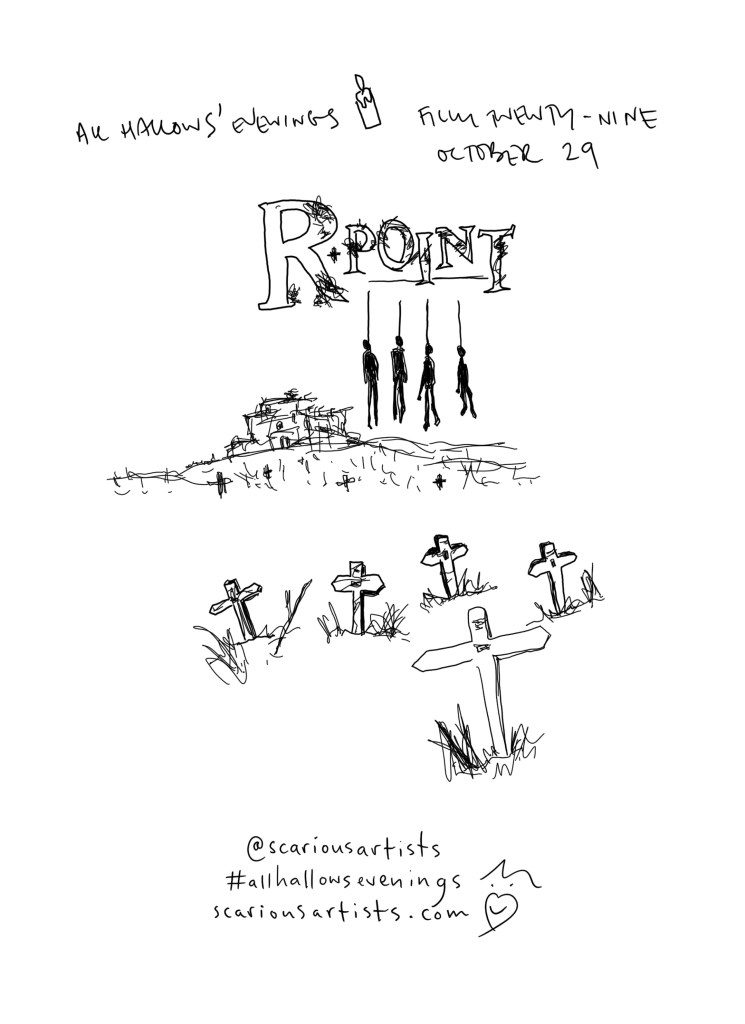
In 2018, myself, my extremely patient girlfriend, and a band of likeminded comrades in Jeonju, South Korea, embarked upon our first ever #horroctober—one horror film every night throughout the month of October. We named ours All Hallows’ Evenings.

It’s not a particularly clever or diverse curation of titles, but it’s what we ended up with, and what we actually saw through to the bloody end. Please enjoy Werewolf Wednesdays, the Dead By Dawn duo (my favourite beer and pizza double bill), a Neve Campbell ’96 pairing, The Witching Hours, a found footage coupling, a frightening Franchise Friday, and the 40th anniversary double feature, Halloween: The Nights He Came Home.

It was a mad rush to finish the accompanying drawings. I used a cool little Wacom Bamboo Slate tablet, which allowed me to draw directly onto paper with the ink pen provided, and digitally convert at the touch of a button using the Wacom app.

This playlist represents the first incarnation of a Scarious Artists project, back in 2012. It began as the throwaway title of a 2CD Hallowe’en compilation—a daft pun on Various Artists, which spiralled each year into a longer, ever-evolving catalogue of mildly macabre party-appropriate (and not so party-appropriate) tunes.

Some lucky souls even got physical copies with handmade, Universal Monster artwork. I made a few of these Hallowe’en mixes over the years, including spooky Hobbycraft felt pouches, and little USB thumbs in coffin boxes with red tissue paper interiors. You can freak out to the digital version below.

Dragnet Me to Hell

Dragnet (1987)

I have crystal clear memories of digging out my Dragnet VHS (taped off the telly) and watching it regularly, in a ritual of my own—sat on our living room carpet, sipping milk and nibbling Jaffa Cakes (always two for some reason). I was aware of Dan Aykroyd from the ’80s kid mega hits, Ghostbusters and Ghostbusters II, as well as The Great Outdoors, and Tom Hanks from other childhood staples like Turner & Hooch (a buddy cop movie of its own), Big, Splash, and The ‘Burbs, so they were the main draw.

Dragnet was directed by Superman and ’70s Bond screenwriter (not to mention uncredited script doctor on WarGames and Gremlins), Tom Mankiewicz—who appears to have a penchant for snake attacks, as he once penned a short outline for Moonraker, which includes a scene reminiscent of the attempted virgin sacrifice in Dragnet where Drax’s pet python develops a crush on Roger Moore’s 007.

Dragnet was an odd film to watch religiously, but back then the films seemed to choose us. We got whatever was deemed decent enough to air on one of four UK terrestrial channels—usually cut to shreds by censors. The splice-happy BBFC chopped out 14 seconds of nunchucks from Dragnet’s theatrical and video versions and Michelangelo knows how much from the Teenage Mutant Hero Turtles, not “ninja” underlined, cartoon as the weapon was heavily restricted.

Dragnet’s prologue highlights the disparities between L.A. natives and immediately showcases the iconic soundtrack with Aykroyd’s eager flathead, Friday’s footsteps stomping assuredly to its dramatic rhythm. The dog in sunglasses representing “race,” Kosher Style Burritos, Best Western mosque motel and quality Donut Hole inserts confidently nail the parodistic tone of what follows—starting with the classic Los Angeles police badge opening titles, now with an added remixed theme.

The Roger Ebert-coined genre term, “Oneza” immediately springs to mind. Uptight Sgt. Joe Friday—namesake nephew of a hero cop uncle, is an anally retentive stickler. Tom Hanks’ Det. Pep Streebeck (greatest character name in cinema history) is the contrasting, hipster freebird—Friday’s lone wolf partner. What follows is buddy cop duo movie playtime. Dragnet has all the noirish, archetypal plot points and ticks every stereotypical trope box of the police procedural, albeit satirical as hell.

There’s the occult secret society gathering resembling Bohemian Grove or a swastika-plastered Nazi rally, incriminating P.A.G.A.N. (People Against Goodness and Normalcy) calling cards left at crime scenes, the car chase joyride complete with a ball-busting interrogation, the polar opposite pairing of Friday and Streebeck going undercover, their long-suffering superior, Capt. Gannon (OG Dragnet’s Harry Morgan) doesn’t believe them of course when they crack the case and subsequently chews them out. There’s a car bomb, a strip club, ethnically stereotypical gang members, a tied-to-a-chair kidnapping, sneaking around, double-crossing, a SWAT team assault, and Friday’s inevitable suspension from the force—meaning he loses his sacred gun and badge—taking our lead protagonist down to his lowest ebb before a triumphant, tank entrance return, set to a powerhouse, Indy-esque score. The spoofy, surreal plane pullover denouement caps it with Friday rescuing the virgin (not for long), Connie Swail, played by Baywatch babe, Alexandra Paul.

Friday: Ma’am, what is the approximate dry weight of the average Madagascan fruit tree bat? Streebeck: You mean you don’t know?

Aykroyd revels in Friday’s loquacious, jargonised monologues as the deadpan, by-the-book sergeant, who vigilantly sticks to federally mandated speed limits, while Hanks practically dances through Dragnet, doing some of his best pre-Oscar noms daft-work. My favourite moments include him recognising every Bait Mate girl at the Playboy Mansion-esque house of lisping, “slut-peddler,” Jerry Caesar, the OTT undercover cover-up laughter, feeding a giant snake hallucinogenic love drugs with his phoney moustache half hanging off, rapping the Miranda rights, performing an impromptu dog puppet show with some goat leggings, and of course, the ensuing goat dance debrief. Finally, the frankly bonkers, Paula Abdul-choreographed Dragnet rap, “City of Crime” feat. MC Hanx and The Notorious D.A.N.’s raucous rhymes. One other standout Hanks line, which I only just got on a recent viewing was his drawling “Highway sixty-oooooone” Bob Dylan reference.

Superman II’s Jack O’Halloran is featured as the sinister, ‘tached arsonist and brilliantly named, Emil Muzz, who honestly always gave me the creeps, and to top it off, there’s M.A.M.A.’s (Moral Advance Movement of America) “mental fur-ball”—the goat-masked P.A.G.A.N. high priest, Reverend Jonathan Whirley, played bizarrely and ominously by Spacey-replacer, Christopher Plummer.

Dragnet isn’t exactly a child friendly film. There’s a partially nude striptease, adult lines like “Prepare the virgin!” and thanks to Muzz’s sweary landlady, Kathleen Freeman (another original Dragnet returnee), we’ve got “pencil dicks” and “asswipes” galore, plus gross gems like “goddamn puss-faced little pimp stick,” “useless, scum-lapping shit bag,” “slimy little jizz bucket,” and “miserable little bag of puke.” It’s certainly a rare bird, and despite being pretty funny and impressive at times—unlike Sylvia Wiss’s 43-year-old breasts, Dragnet hardly “borders on the spectacular.” It does, however, play particularly well in a double bill with another forgotten ’80s Aykroyd (and Chevy Chase) peculiarity, Spies Like Us.

Dragnet is seemingly in movie jail, with a Google search favouring the ’50s TV series and its spinoffs over the 1987 movie, but it’s eligible for parole now. So go through your “boxes of smut,” dig out that dusty VHS or DVD, track it down on a streaming service (you’ll be lucky), or grab that Shout! Factory Collector’s Edition Blu-ray, some chewing gum and a Snickers bar, and peer back into the days of the ol’ 4:3 family telly.

Pee-wee’s Big Rewind

Kooky cult comedy antics abound in this ’80s double bill oddity, starring Paul Reubens as his madcap Groundling creation, Pee-wee Herman. Adorned in a grey suit, white high-heeled shoes (“tequila!”) and a little red bowtie, the petulant, childlike roars and idiosyncratic shenanigans of Reubens’ character were lapped up by an infantile me, endlessly looping a homemade Big Adventure tape.

What was the draw? Firstly, I found it immensely engaging and incredibly funny, but Pee-wee is about as distant from my onscreen heroes like Bond or Indy as you could possibly imagine. A skinny, effeminate, asexual manchild with a penchant for cute dogs, frequenting joke shops, and riding an ostentatious, campy red bicycle. It’s enough to make parents concerned. Whilst my masculine, manly-man quota was jam packed with Michael Knight, The A-Team, and Magnum P.I., Reubens’ alter ego was arguably a yin to their yang – anima indulgence, in the way a northern lad solely watching Rocky and Top Gun could never access.

In terms of the comedy, Pee-wee’s Big Adventure (scripted by Reubens and a pre-SNL Phil Hartman, drawing on the 1948 Italian neorealist drama, Bicycle Thieves as inspiration) lays it on pretty thick. I’d estimate around 60-70% of it still sticks. Whether that’s a case of the funnies themselves aging, or the fact that Pee-wee split audiences back in the 1980s (and likely always will), I’m uncertain. The breakfast making machine, bitter interactions with the intolerable “Francis!” (my favourite moment of his has him monstrously destroying model battleships at bathtime in his giant indoor swimming pool) and the escaped convict hitchhiker in Big Adventure all had me chuckling again, but this time around it was Pee-wee’s misunderstood recounting of a dream that really made me howl.

Simone: Do you have any dreams? Pee-wee Herman: Yeah, I’m all alone. I’m rolling a big doughnut and this snake wearing a vest…

The Pee-wee films are not without a big scoop of nostalgia for me. I remember them fondly for all their delirious exploits and the early directorial flourishes of Tim Burton, whose movies like Batman, Batman Returns (where Reubens played The Penguin’s monocled father), and Beetlejuice were also on regular VHS rotation. Upon the latest rewatch, Francis’ gothic, striped towel stood out like a Burton-shaped sore thumb, and what says Tim Burton more than a snake in a vest? This being his first live action feature film, it’s an early insight into Burton’s bizzaro outsider protagonists of choice, and it evidently paved the stripey black and white road for later incarnations of oddness ahead.

My memory of falling in love with Valeria Golino as Gina Piccolapupula in the sequel, Big Top Pee-wee is vivid, perhaps partially due to her other sultry roles at the time in Hot Shots! and Hot Shots! Part Deux. Randal Kleiser (director of Grease, Flight of the Navigator, and Honey, I Blew Up the Kid) toes the line in terms of Reubens’ and Burton’s already established aesthetics. There’s the welcome inclusion of Vance—the chatty, anthropomorphised pig, and some further underlying absurdity, particularly noticeable in the freaky, Tod Browning-esque circus folk, featuring a human pretzel, a hermaphrodite, a tiny pixie wife, conjoined twins, a mermaid in a bath, Kevin Peter Hall as Big John, and a brief film debut by Benicio del Toro as Duke, the Dog-Faced Boy. Big Top also boasts a hearty, dignified performance from Kris Kristofferson as circus ringmaster, Mace Montana—a befitting counterweight to Herman. He’s as close to a dad as the fatherless Pee-wee gets.

The sexuality of Herman, although something which never dawned on me as a child, is thought provoking. There’s not a hint of it in Big Adventure. In fact, Pee-wee actively dodges a drive-in date with his admirer, Dottie (until the end) and seemingly has little interest in women, even as he’s entwined in his 007 fantasies, but by the time Big Top rolled around, so did Pee-wee, literally, on a picnic blanket with schoolteacher and reluctant girlfriend, Winnie.

Although the infamous South Trail Cinema incident looms large in Pee-wee lore, the “victimless occurrence,” as Pee-wee’s Playhouse collaborator and buddy Cyndi Lauper put it, perhaps shouldn’t, and personally doesn’t alter my view or enjoyment of the films. The movies have enough in the bank with me, but for some, it did shatter the sexual ambiguity of Pee-wee, albeit via Reubens, who notably, to indulge the illusion that Pee-wee is real, prefers to be credited as the titular character—an error in judgment in retrospect perhaps, as it never allowed a line to be drawn between Paul and his Pee-wee persona.

We don’t know Pee-wee’s age, he has no job we’re aware of, yet puzzlingly resides in a playhouse packed with gadgets “Doc” Brown would flip over. It’s all fantasy. The type that indulges the mind of a child and throws a monkey wrench into the brain of an adult. I had to put my childhood eyes back in to experience Pee-wee like before, but once I was acclimated, it took me back like time travel in a way that only a handful of films can. Amid the madness, there is the pointed, poignant message to misfits that “it’s okay to be different.” Pee-wee exemplifies this and let’s face it, there are far worse sentiments you could impart to the kids of the world. For me, both films are akin to looking back at photographs of simpler, happier times with a life yet to be lived. They’re tinged with a sliver of sadness. A melancholy. Perhaps it’s the image of a man completely in tune with himself but so out of whack with others. Although in these movies, Pee-wee is predominantly embraced by people and it’s his own peculiarities that alienate him.

There’s still something off-kilter about it all: the histrionic performances, quirky art direction and design, Danny Elfman’s urgent score music—yes. But also on an unintentional level. Something outside the filmmakers’ control, like Lynchian creepy crawlies lurking beneath a white picket fence. Not depravity or lewdness. Something harder to pin down. There’s palpable discomfort when Pee-wee peers into the lens, bids us good morning and whispers, “I’m here!” It’s weird enough to disturb, saccharine enough to churn the stomach a little, and artful and intriguing enough to justify a big rewind. “Be sure an’ tell ’em Large Marge sent ya!”